
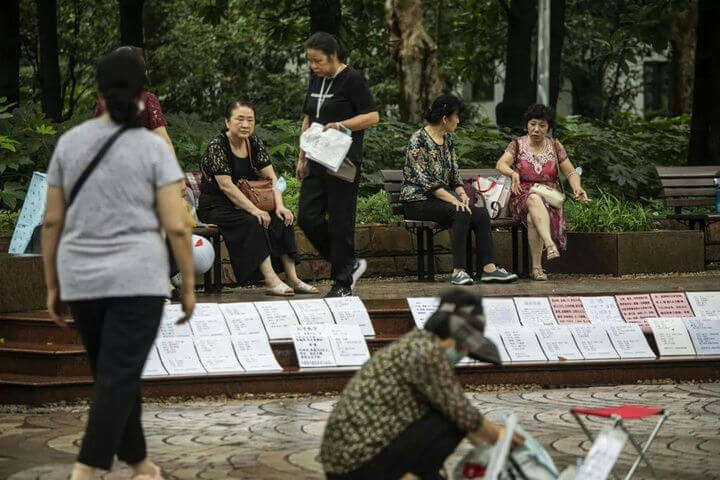
In parks across major cities in China, weekends bring a unique social phenomenon: crowds of parents—many retired—converge under leafy trees with stacks of documents in hand. They’re not attending a community meeting or seniors’ club. Instead, they’re participating in China’s “marriage markets” , a grassroots matchmaking event where parents seek life partners for their adult children .
These markets began in the early 2000s, partly as a byproduct of the 1979 one-child policy , which, while curbing population growth, skewed gender demographics in favor of men. Decades later, the imbalance has left millions of Chinese men struggling to find spouses in a modern marriage landscape increasingly shaped by education, economic independence, and evolving social norms.
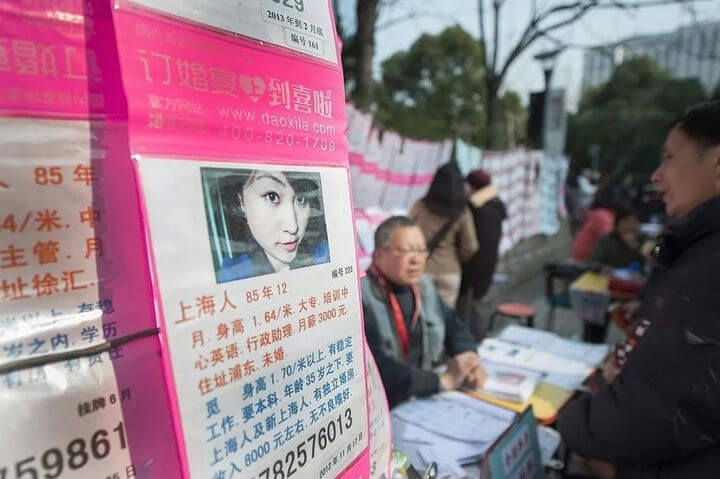
At People’s Park in Chongqing , Friday and Saturday mornings see hundreds of parents displaying meticulously written “marriage résumés” detailing their children’s age, height, job, income, and other criteria. Photos and names are typically omitted, but the profiles still draw attention like offline dating ads pinned to nature.
These resumes don’t shy away from practical demands. One listing specifies a groom must be under 29, taller than 1.63 meters, weigh about 64 kilograms, earn at least $560 a month, and own stable assets. Height, income, and housing remain top priorities in these highly competitive matchmaking arenas.
These markets reflect anxieties among older generations about their children staying single, especially as China’s marriage and birth rates plummet . In 2024, only 6.1 million new marriages were recorded nationwide — an all-time low for a country of 1.4 billion.

Despite the abolition of the one-child policy in 2015, its effects linger. Men still outnumber women by tens of millions. Meanwhile, many urban women—especially only daughters from affluent, well-educated families—enjoy financial independence and no longer view marriage as essential.
China has rolled out child care subsidies and pro-natal policies to reverse these trends, but they’ve had little success so far.
Though driven by concern, some parents take matchmaking into their own hands because their children are disinterested. Others attend the market out of social habit — a place to chat, trade advice, or even discuss real estate prices.
Some younger singles, like Zhang Jing , a 34-year-old sales professional, have tried participating directly. Initially, her mother brought her profile to the market, but after multiple disappointments, she decided to go herself.
“We’re not picky,” she said. “But many just don’t meet the basics — like a stable income or owning a home.”
On the other side of the equation is Huang Weiming , 36, a marketing specialist with a home, car, and annual income of $17,000. His only requirement for a partner: a slim figure and shared values.
“People expect too much from men,” he lamented. “If I haven’t met the right person by 40, I’ll accept being single.”
The first marriage markets reportedly appeared in Beijing in the early 2000s and have since spread nationwide. While success stories are rare, the gatherings continue to draw large crowds, especially among parents who see it not just as matchmaking, but also as emotional support and social bonding.
The laminated resumes dangling from string lines in Shanghai’s parks have become a poignant symbol of urban China’s demographic crossroads — where love doesn’t always begin with the heart, but often, with the loving concern of parents .
Sources: kenh14
You must be logged in to post a comment.