

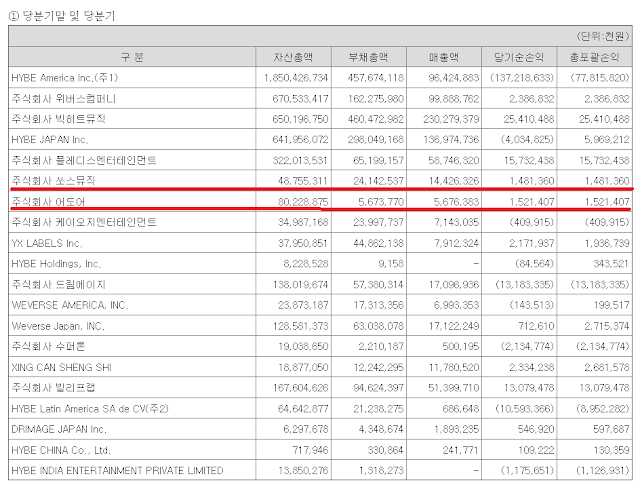
A newly revealed financial report from HYBE has sparked heated discussion online after showing an unexpected result: despite Source Music generating significantly higher revenue through LE SSERAFIM’s active promotions, tours, and album releases, ADOR reportedly recorded a higher net profit, even as NewJeans remained largely inactive.
According to figures circulating online, Source Music’s overall revenue was approximately 2.5 times higher than ADOR’s due to LE SSERAFIM’s steady comeback schedule and global activities. However, when it came to final net earnings, ADOR reportedly came out ahead, posting more than 1.52 billion KRW in profit.
Industry observers and netizens have pointed to several key reasons behind the surprising outcome.
First, NewJeans’ previously released mega-hits including “Ditto,” “Hype Boy,” “OMG,” and “Super Shy” continue to generate massive and highly stable streaming numbers across platforms such as Spotify and Melon. These long-lasting music royalties reportedly provide ADOR with a strong source of recurring income without requiring new production investments.
Second, ADOR’s debt burden is said to be significantly lower, estimated at only about one-quarter of Source Music’s liabilities. Without the heavy expenses tied to album production, comeback promotions, travel, choreography, stage design, and large-scale performances, ADOR may have been able to maximize its profit margin more efficiently.

Third, revenue from luxury brand ambassador deals and individual advertising contracts involving NewJeans members is believed to play a major role. These endorsement agreements are often highly lucrative for management agencies, allowing ADOR to maintain a strong cash flow despite reduced group activities.
The financial comparison has fueled intense debate among fans and online communities, with some viewing the figures as proof of NewJeans’ lasting commercial power, while others argue that active promotions and long-term business investments should also be taken into account when evaluating an agency’s performance.
Sources: Instiz
You must be logged in to post a comment.