

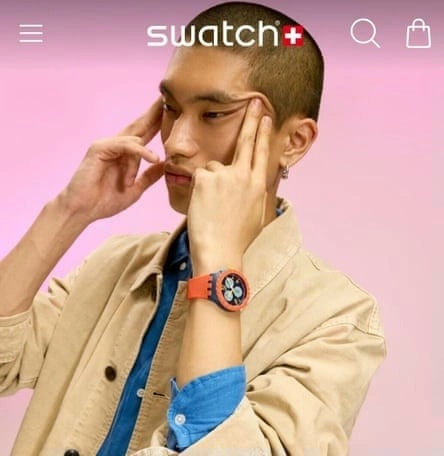
The controversy centers on the Swatch Essentials collection, which featured a male model pulling the corners of his eyes to mimic a “slanted eyes” appearance. This gesture, widely condemned on Chinese social media, was seen as mocking Asian facial features—a recurring symbol of racial stereotyping.
On August 16, Swatch released an official apology on Weibo, stating that the company had “taken note of the recent concerns” and had removed the campaign images worldwide. The apology, published in both English and Chinese, added: “We sincerely apologize for any discomfort or misunderstanding caused by this.”
The timing could not be worse for Swatch, whose stock has plummeted over 50% since early 2023. The company also faces a 39% tariff on exports to the U.S., compounding its financial pressures.
Swatch, which also owns luxury watch brands like Omega, Longines, and Tissot, is heavily reliant on China. In 2024, around 27% of its total revenue came from mainland China, Hong Kong, and Macau. The company recently reported a 14.6% drop in revenue, down to 6.74 billion Swiss francs (approx. $8.4 billion), attributing the decline to sluggish consumer demand in China.
According to CNN, the act of imitating slanted eyes has long been associated with racial mockery. The gesture has historical roots dating back to the 1930s, when Americans distorted eye shapes to caricature Asian people—each ethnic group targeted differently: slanted upward for Japanese, stretched horizontally for Chinese, and downward for Koreans.
In 2020, a beauty trend known as the “fox eye” makeup style, which featured lifted and elongated outer eye corners, was also criticized as a form of cultural appropriation and racial insensitivity, despite its popularity among global youth.
Swatch is not alone in facing such scrutiny. In 2023, Dior similarly apologized and removed an ad that depicted an Asian model with exaggeratedly slanted eyes. Earlier, Prada (2018) pulled products accused of mimicking Blackface imagery, and Dolce & Gabbana faced a widespread boycott in China over a video showing an Asian model awkwardly eating Italian food with chopsticks. In 2019, Gucci also had to withdraw a sweater criticized for resembling Blackface.
These incidents reflect ongoing tensions between global fashion houses and culturally sensitive markets like China, where consumer backlash can swiftly impact brand image and revenue.
Sources: vnexpress
You must be logged in to post a comment.