
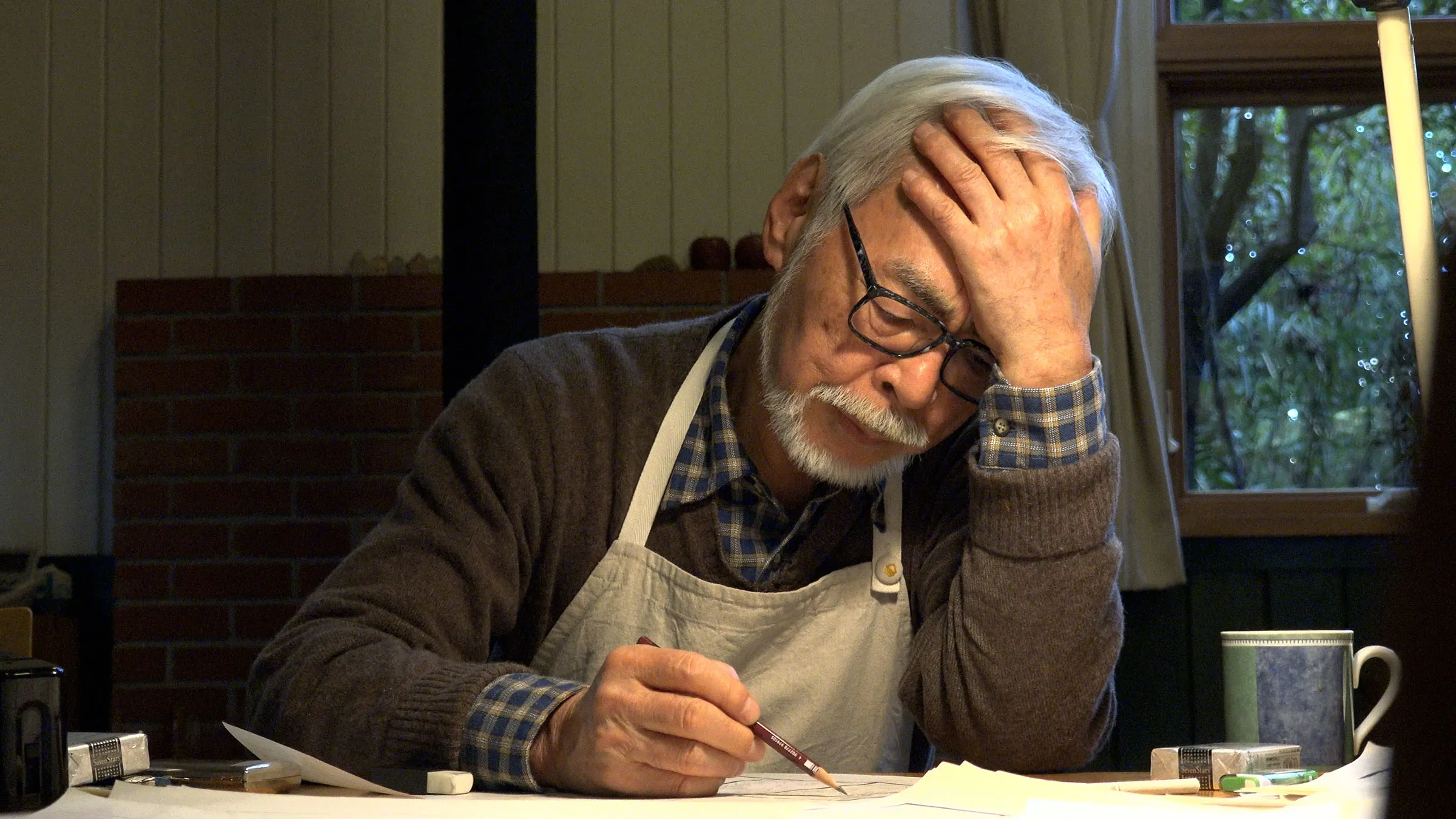
Miyazaki Hayao, a legendary anime genius, is a mix of contradictions: he hates war but loves fighter planes, works tirelessly yet is not a family man, and acknowledges life’s darkness while praising the good. His philosophy aligns with Antonio Gramsci’s: “Pessimism of the intellect, optimism of the will.”
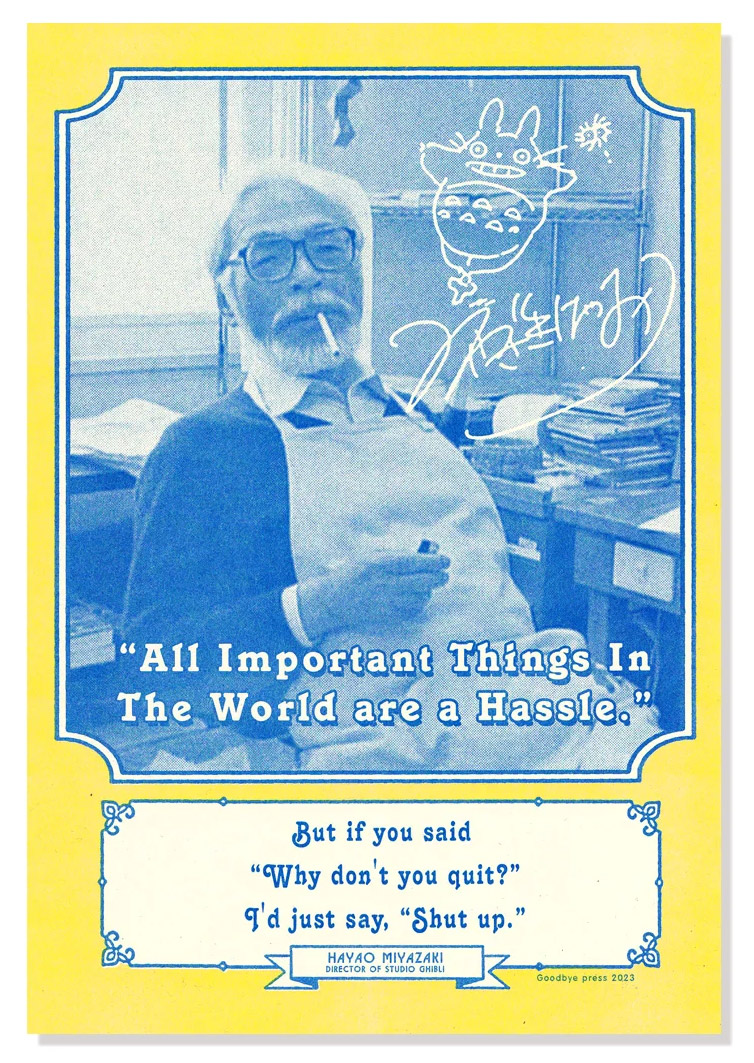
Let’s take a look back at the career journey of the founder of Studio Ghibli on the occasion of his 84th birthday.
Table of contents
Childhood and Inspiration
Miyazaki Hayao was born in 1941 in Tokyo during World War II, and his earliest memories were of cities ravaged by bombing. His family evacuated multiple times, once to his grandfather’s estate, where the garden deeply influenced his creative style and love for nature, a recurring theme in his films.

Although his family owned a company that produced fighter planes, Miyazaki was conflicted about their involvement in the war, particularly his father’s exploitation of it for profit. Despite being a pacifist, Miyazaki had a fascination with planes, a theme that frequently appears in his works.
At age six, Miyazaki’s mother contracted spinal tuberculosis and was bedridden for eight years. Her strength and resilience profoundly impacted him, reflected in the many strong female protagonists in his films.

Miyazaki developed a passion for drawing early on. Despite criticism for mimicking Tezuka Osamu’s style, he pursued a degree in political economics. However, his love for art led him to join Toei Animation in 1963 after graduation.
A Lifetime of Struggles
Miyazaki began as an in-between animator, quickly showcasing his exceptional talent. He became close collaborators with Takahata Isao, working as his right-hand man on Takahata’s directorial debut, “The Great Adventure of Horus, Prince of the Sun” (1968), where Miyazaki designed key scenes and led animation. As both grew increasingly ambitious, they left Toei in 1971 to explore new opportunities.

During a trip to Sweden for “Pippi Longstocking” rights negotiations, Miyazaki developed an affection for European landscapes, which influenced future projects. He took on more significant roles, co-directing “Lupin III” (1971-1972) and “Panda, Baby Panda” (1972). In 1978, his first personal series, “Future Boy Conan,” was released, although it was credited to Otsuka Yasuo. Miyazaki soon moved on to direct “Lupin III: The Castle of Cagliostro,” which, despite not being a box-office hit, became a classic and influenced filmmakers like John Lasseter.

The production of “The Castle of Cagliostro” was challenging, with only seven months for completion. Miyazaki worked tirelessly, often sleeping at the studio, which affected his family life. His eldest son, Goro, recalled his father’s long sleep during rare visits home, leading Miyazaki to apologize for not having enough time for him.
At the time, Miyazaki’s wife, Ota Akemi, took on both parental roles. Though Akemi earned a higher salary and was an accomplished animator, she had to stay home to care for their children, as Miyazaki’s career demanded his full attention. While Akemi never publicly criticized their marriage, Miyazaki admitted that she never forgave him for the sacrifices she made.
A Turning Point in Life
During the production of “Lupin III: The Castle of Cagliostro,” Miyazaki met editor Suzuki Toshio, whose persistence led to a legendary collaboration. Initially reluctant, Miyazaki eventually agreed to meet Suzuki, who proposed making a film for Tokuma Shoten. The idea for “Nausicaä: The Valley of the Wind” was initially rejected due to budget constraints and the lack of a manga, but Suzuki suggested Miyazaki first create the manga. This led to the creation of Princess Nausicaä, a character inspired by legends, leadership, and a love for nature.
The manga was a huge success, prompting Tokuma Shoten to greenlight an anime adaptation. Miyazaki chose Takahata Isao as the producer and Hisaishi Joe for the music. Despite a challenging nine-month production, “Nausicaä” was released in 1984, becoming one of the greatest anime films.
However, the American release on HBO was heavily edited without Miyazaki’s consent, renaming the film “Warriors of the Wind” and distorting the story. This led to disappointment, as the film was promoted with an unrelated poster. Despite this setback, the success in Japan confirmed for Miyazaki, Takahata, and Suzuki that they wanted to create high-quality, vivid animation films under their own studio, leading to the founding of Studio Ghibli.
The Birth of Studio Ghibli
In 1985, Miyazaki Hayao, Takahata Isao, and Suzuki Toshio founded Studio Ghibli, named after the Italian Caproni Ca39 Ghibli aircraft, symbolizing a “new wind” in Japanese animation. Unlike other studios focusing on series or OVAs, Ghibli took the risk of producing high-quality theatrical anime films, prioritizing artistic creativity over profit.

The first film, “Laputa: Castle in the Sky” (1986), directed by Miyazaki and produced by Takahata, follows a boy, Pazu, and a girl, Sheeta, on their journey to the legendary Laputa. Inspired by a 1984 visit to Wales, Miyazaki recreated the mining region’s landscape and the spirit of the miners’ struggle. The antagonist, Muska, was more complex than typical villains, though Miyazaki admitted the character remained unfinished due to the film’s focus on children. While it didn’t surpass “Nausicaä: The Valley of the Wind,” “Laputa” helped Ghibli continue to grow.

At the time, Takahata was working on “Grave of the Fireflies,” and Miyazaki on “My Neighbor Totoro.” Both directors had doubts about the box office potential of their films—Takahata’s was too sad, and Miyazaki’s was too simple. However, Suzuki insisted both films should be made and released together. Despite the small staff, producing two films simultaneously pushed the directors and created healthy competition between them, driving them to complete the challenging projects.
Both films were released in 1988. While they didn’t match the box office success of “Nausicaä” or “Laputa,” Ghibli profited through other avenues, and “My Neighbor Totoro” unexpectedly broke records for toy sales. Totoro’s image became a symbol of Studio Ghibli.
A Career Breakthrough
The first Ghibli film to achieve major box office success, topping Japan’s charts in 1989, was “Kiki’s Delivery Service.” Based on Eiko Kadono’s novel, the film follows a 13-year-old witch, Kiki, who sets out to complete her training. Inspired by Miyazaki’s trip to Sweden, the fictional city of Koriko resembles Swedish cities like Visby and Stockholm. The film explores themes of growing up and loneliness, offering lessons for both children and adults.

Miyazaki’s next film, “Porco Rosso” (1992), based on a short manga, tells the story of a pilot turned pig during WWI. While it has a humorous premise, the film is deeply romantic and anti-war, with Miyazaki’s passion for airplanes shining through. Production was challenging, as Miyazaki had to take on multiple roles due to staff availability.
In the 1990s, Miyazaki cemented his status as one of Japan’s top directors with “Princess Mononoke” (1997). The film blends hand-drawn animation with computer technology and explores environmental issues. The story centers on Prince Ashitaka, torn between two sides: Princess Mononoke, who wants to destroy Iron Town to save the forest, and Lady Eboshi, who seeks to exploit the forest for industrial growth. The film’s complex characters, especially Eboshi, reflect Miyazaki’s nuanced approach to storytelling. “Princess Mononoke” became Japan’s highest-grossing film at the time and caught the attention of Disney, who sought U.S. distribution. However, Miyazaki reportedly sent Disney a katana sword as a warning not to alter the film.
Retirement and Comeback
In 1998, Studio Ghibli was shaken by the death of Kondo Yoshifumi, Miyazaki’s top pupil, from an aneurysm caused by overwork. Many believed this prompted Miyazaki’s retirement, though it was also influenced by his declining eyesight after completing “Princess Mononoke.”

However, Miyazaki didn’t fully leave the animation world. He focused on designing the Ghibli Museum, which opened in 2001, and also released “Spirited Away” that same year. The film became a huge success, winning the Academy Award for Best Animated Feature in 2002. Miyazaki didn’t attend the ceremony due to his opposition to the Iraq War, which influenced his next film, “Howl’s Moving Castle” (2004).

“Howl’s Moving Castle” reflected Miyazaki’s memories of WWII, depicting a tragic war. It was nominated for an Oscar but didn’t win, although Miyazaki received the Golden Lion Award at the Venice Film Festival.
Ghibli also acquired the rights to adapt Ursula K. Le Guin’s “Earthsea,” with Goro Miyazaki, Miyazaki’s son, chosen to direct. Despite Miyazaki’s initial opposition, Goro’s film was a success, and later Miyazaki praised it as a true achievement.
Official Retirement
In 2006, Miyazaki traveled to England for inspiration and was influenced by the Pre-Raphaelite movement. Upon returning to Japan, he simplified his drawing style, leading to “Ponyo” (2008), which was created using storyboards instead of a script. Despite only having half the film completed when production started, “Ponyo” became a commercial success.

As he aged, Miyazaki’s health declined, and he worked slower, using softer pencils. This led him to create his final film, “The Wind Rises” (2013), based on his manga. The film focused on aircraft designer Jiro Horikoshi, who created the Mitsubishi A6M Zero during WWII. Miyazaki was initially reluctant but was convinced by producer Suzuki.

“The Wind Rises” explored Japan’s militarism and reflected Miyazaki’s views. The production involved recreating pre-war Japan with old photographs for reference. Despite Japan’s 2011 disaster, Miyazaki remained dedicated to the film, which won Animation of the Year in Japan.
Though nominated for an Oscar, it lost to “Frozen.” Miyazaki felt his era had ended due to the toll on his health and the lengthy production. After completing “The Wind Rises,” he retired for the third time in 2013, receiving an honorary award in 2014. He continued creating short films for the Ghibli Museum after his retirement.
The Man Who Couldn’t Stop Working
Miyazaki, driven to ensure the Ghibli Museum’s survival, was chronicled in the 2016 documentary “Never-ending Man: Hayao Miyazaki.” Despite his reluctance to be in the spotlight, he jokingly called himself the “Man Who Couldn’t Stop Working.”
In 2017, Miyazaki announced his fourth and final film. Facing aging and the loss of friends like Takahata Isao, he chose to create a film for his grandson, marking the end of his journey. The film, released in 2023, won Best Animated Feature at the 2024 Academy Awards.

Miyazaki’s genius is clear. He sacrificed his personal life for animation, leaving behind fairy tales full of light, darkness, and hope.
You must be logged in to post a comment.