

The controversy surrounding BJ Juice Seyeon (real name In Seyeon), who was recently dropped as a cosmetics brand model after public backlash, has taken an unexpected turn—this time involving a major advocacy group.
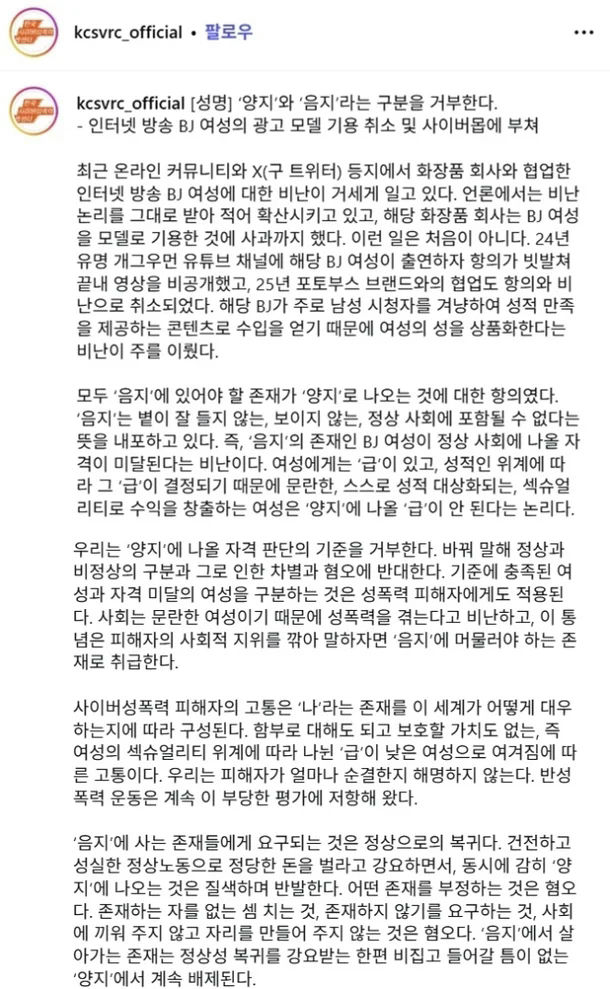
The Korea Cyber Sexual Violence Response Center, a private organization that supports victims of cyber sexual violence, issued a statement defending Juice Seyeon. However, instead of calming the situation, the statement triggered strong backlash, even from the group’s own supporters.

Earlier, on April 20, Juice Seyeon uploaded an advertisement video for a natural cosmetics brand on her YouTube channel. Soon after its release, criticism flooded online communities and the brand’s official forums. Many argued that a brand requiring a clean and trustworthy image had chosen a model who profits from sexualized content. As the controversy escalated, the brand and its CEO issued a formal apology and took steps to recall all related products.
On April 23, the Korea Cyber Sexual Violence Response Center released a statement criticizing the public backlash against the influencer. The group argued that the criticism stemmed from discomfort with individuals perceived to belong in the “shadows” stepping into the “mainstream.” They further claimed that society imposes a hierarchy on women’s sexuality, suggesting that women who profit from sexual content are deemed unworthy of public visibility.

The organization also linked such attitudes to harmful narratives often directed at victims of sexual violence—such as blaming victims for being “promiscuous.” They emphasized the need to dismantle these stigmas.
However, the statement quickly sparked intense criticism. Many netizens argued that equating victims of sexual violence with adult-content broadcasters was inappropriate and disrespectful to actual victims.
At the heart of the backlash is the argument that voluntary production of sexualized content should not be placed on the same level as involuntary experiences of sexual violence. One supporter wrote on social media that statements like this could, in fact, silence victims rather than protect them, criticizing the group’s stance as conflicting with its core mission.
Others also pointed out that in an online environment accessible to minors, the social implications of earning money through adult broadcasting cannot be overlooked.
The organization, which had previously built a strong reputation through its work on major cybercrime cases such as the Nth Room case, is now facing internal and public scrutiny. The controversy has evolved beyond a simple disagreement, igniting a broader debate over the principles and boundaries of victim advocacy in the digital age.
Sources: Daum
You must be logged in to post a comment.