

The case was recently revisited in JTBC’s investigative program “Crime Chief” on July 17, highlighting the timeline of abuse and the legal loopholes that failed to adequately protect the victim.
Relationship Turned Nightmare
The victim and the well-known male broadcast jockey (BJ) dated briefly for two months in 2020. After she ended the relationship citing incompatibility, the BJ began a series of public retaliations through his online broadcast—followed by over 3.16 million viewers.
In his live streams, the BJ revealed personal items such as the victim’s sanitary products and cosmetics, using them to humiliate her on air. He threatened to further expose her private life and shared information about their relationship in open chat rooms and with news outlets.
He even falsely contacted journalists, claiming he had suffered emotional abuse during their relationship, and submitted fabricated evidence, including alleged audio recordings.
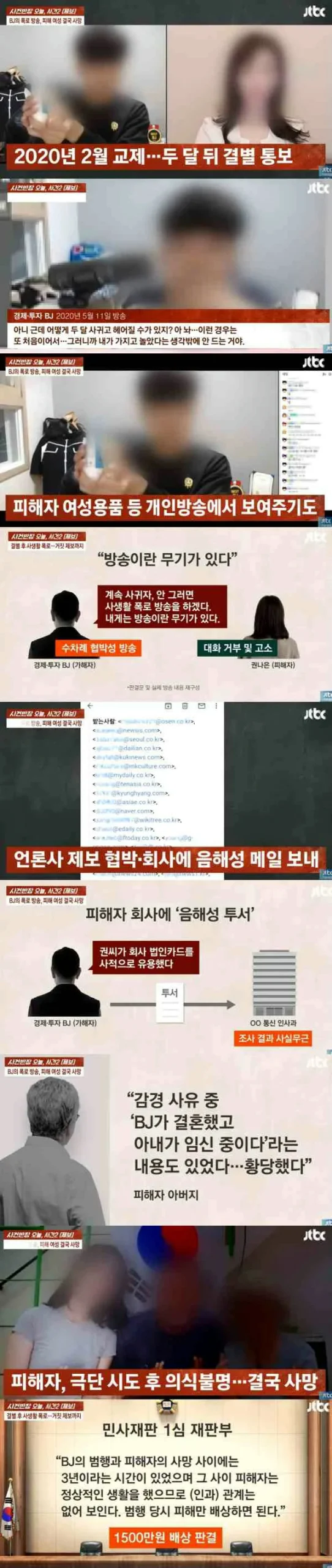
The abuse extended into her workplace. The BJ filed false reports with the company’s ethics board, accusing the victim of using a corporate credit card for personal expenses during their relationship. An internal investigation found no misconduct, but the stress severely impacted the victim’s mental health.
Legal Response and Continued Trauma
The victim filed criminal charges against the BJ for defamation and attempted coercion. However, the court initially sentenced him to one year in prison, suspended for two years, citing as mitigating circumstances that he had since married and had a pregnant spouse—a rationale that sparked public disbelief.
Despite this, the victim pursued an appeal. During the process, she attempted suicide, fell into a coma, and later passed away. The appeal court increased the sentence to 2.5 years imprisonment, suspended for 4 years, but this ruling came after her death.
Civil Suit and Controversial Ruling
The victim’s family pursued a civil lawsuit, seeking damages for medical costs, funeral expenses, and lost future income, amounting to approximately 500 million KRW (approx. $360,000 USD). However, the court ruled there was insufficient causality between the BJ’s actions and the victim’s death, citing a three-year gap between the incidents and her passing.
Instead, the court awarded just 1 million KRW (approx. $700 USD) for emotional distress, acknowledging defamation but not the connection to her death.
Lawyer Yang Ji-yeol criticized the judgment, noting that courts in South Korea often hesitate to link a victim’s suicide to a perpetrator’s actions, especially when time has passed. “It is precisely because she endured three years of relentless psychological pain that she made the ultimate decision. That continuous suffering should not be dismissed simply due to the passage of time,” he stated.
This case has reignited national discussions on cyber abuse, victim protection laws, and the inadequacy of legal systems in addressing emotional and reputational damage—particularly for female victims of online harassment.
Nate
You must be logged in to post a comment.