

On January 26, the South China Morning Post reported that Xing Yun publicly criticized the crew she worked with last year for what she described as abusive treatment of a baby during filming. A clip shared in the controversy shows Xing Yun’s character—a businessperson—approaching a soaked mother and infant, offering an umbrella and cash.
Xing Yun recounted that the weather was unusually cold and that a water truck was used to pour heavy rain over the set. The baby held by a fellow actress was left standing in the downpour for extended periods. “My heart broke watching the child cry so pitifully,” she said. “I felt angry and helpless.”
According to Xing Yun, the production chose not to use a baby doll to save time. “If the umbrella had been held lower, it could have shielded the child,” she said. “But the director refused, saying it would block our faces in the shot.”
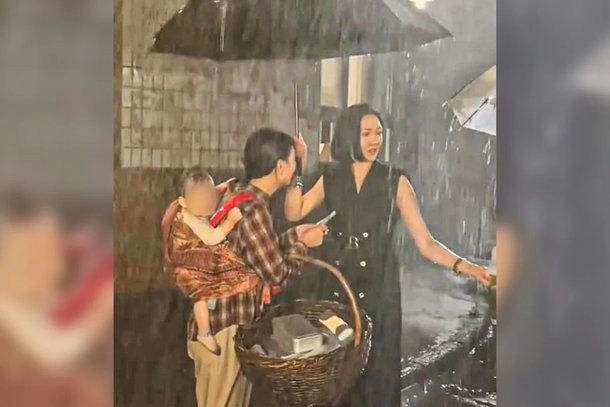
She further criticized the production, saying, “They always push actresses and child actors to their limits. I can accept personal hardship, but I cannot stand to see the same suffering inflicted on a baby.”
The infant actor reportedly received just 800 yuan (about ₩160,000) for the role—an amount that has fueled public outrage and concerns about exploitation.
Netizens reacted strongly online: “This is child abuse. The ruthless production team and those parents deserve criticism,” and “Some parents treat their children like money‑making tools. They have no right to be parents.”
Xing Yun also recalled a previous harsh filming experience in Xi’an, where she had to run barefoot on gravel in cold conditions, with the baby placed in a trash truck as part of the scene.
As the Chinese mini‑series industry booms, extreme production practices—such as shooting 100 episodes in seven days to save costs—have become more common, raising alarm over the well‑being of young performers.
In response, Chinese authorities introduced new regulations on January 8 aimed at protecting child actors, banning overly violent, emotionally intense, or physically demanding scenes that exceed children’s capabilities.
However, many young performers still endure grueling conditions, including 16‑hour filming days, heavy costumes, and wire stunts under harsh sunlight. Just this January, a controversial mini‑series featuring an 11‑year‑old girl in inappropriate scenes with an adult actor was removed entirely after public uproar.
The latest revelations about rain exposure for a baby actor—and the minimal pay involved—have only intensified calls for stricter oversight and better protection of children in the entertainment industry.
Sources: Nate
You must be logged in to post a comment.