
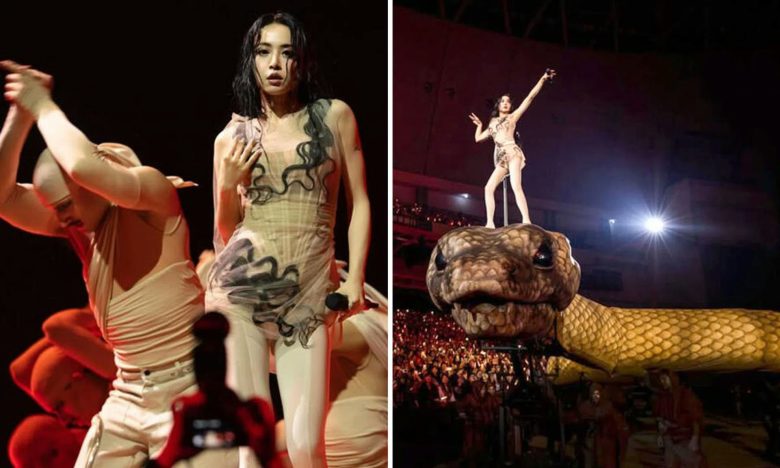
The Taipei stop of Jolin Tsai’s “PLEASURE” concert tour has unexpectedly become the center of intense controversy on social media, as waves of netizens coordinated mass reporting campaigns across multiple platforms and called on authorities to revoke the concert’s performance license. The backlash stems from accusations that the show contains excessive “spiritual” and “religious” elements, with some individuals reportedly submitting formal complaints directly to cultural regulatory agencies.

Following the rapid circulation of concert clips online, social media platforms were flooded with so-called “analysis” videos dissecting the stage design, choreography, and visual imagery. Some netizens claimed that movements performed by Jolin Tsai on stage symbolized the act of “absorbing luck and wealth from the audience,” further speculating that these gestures aligned with the principles of the alleged Guang Ming Association. These videos quickly amassed millions of views, fueling heated debates and widespread speculation.
Comment sections beneath the viral clips took a controversial turn, with some users asserting that “those who attend Jolin Tsai’s concerts are generally well-off and financially comfortable,” suggesting that such audiences were deliberately targeted as sources of fortune for the singer. These claims, largely based on conjecture, further intensified public discourse.
The situation escalated as additional posts labeled the concert as “bizarre,” “cult-like,” and even accused Jolin Tsai of “sacrificing fans,” prompting renewed calls for complaints to be filed with cultural authorities. “Perhaps she is the most unfortunate singer in the world,” one sarcastic post read, alleging that the artist was “using stage symbols as ritual tools.”
Despite Jolin Tsai’s team issuing legal clarifications through official lawyer statements, the controversy failed to subside. Matters intensified when the singer herself reportedly filed reputation-right complaints under her real name, resulting in the removal of several analysis videos—an action that paradoxically led to even wider dissemination of the rumors.
The controversy reached its peak when the keyword “Jolin Tsai’s 200 million RMB concert loses over 70 million” surged to the No.1 trending position. Taiwanese media later reported that the three concerts held at Taipei Dome incurred an estimated loss of 340 million TWD. Industry insiders, however, emphasized that such losses were anticipated due to massive upfront production costs, including large-scale mechanical creatures, oversized stage props, and a fully immersive 360-degree stage design. Upcoming tour stops in Shenzhen and Xiamen, spanning four shows, are expected to gradually offset these costs as the tour continues.

In contrast, fans and industry professionals have widely praised the concert, describing it as “a ceiling-level production in the Mandarin pop music industry.” The heavy investment in mechanical stage elements, panoramic stage construction, and full live vocals has been recognized as a new benchmark for large-scale concert production. Many observers argue that the complaints reflect narrow aesthetic perspectives, stressing that artistic expression should allow for diverse forms and interpretations.
According to reports, the number of complaints related to the concert has reached the hundreds, submitted to cultural and tourism bureaus as well as cultural law enforcement agencies across multiple regions. Nevertheless, Jolin Tsai, through her team, has maintained a firm stance: artistic creativity should not be constrained by superstition or forced interpretations imposed from outside the realm of art itself.
Sources: Netizenbuzz
You must be logged in to post a comment.