
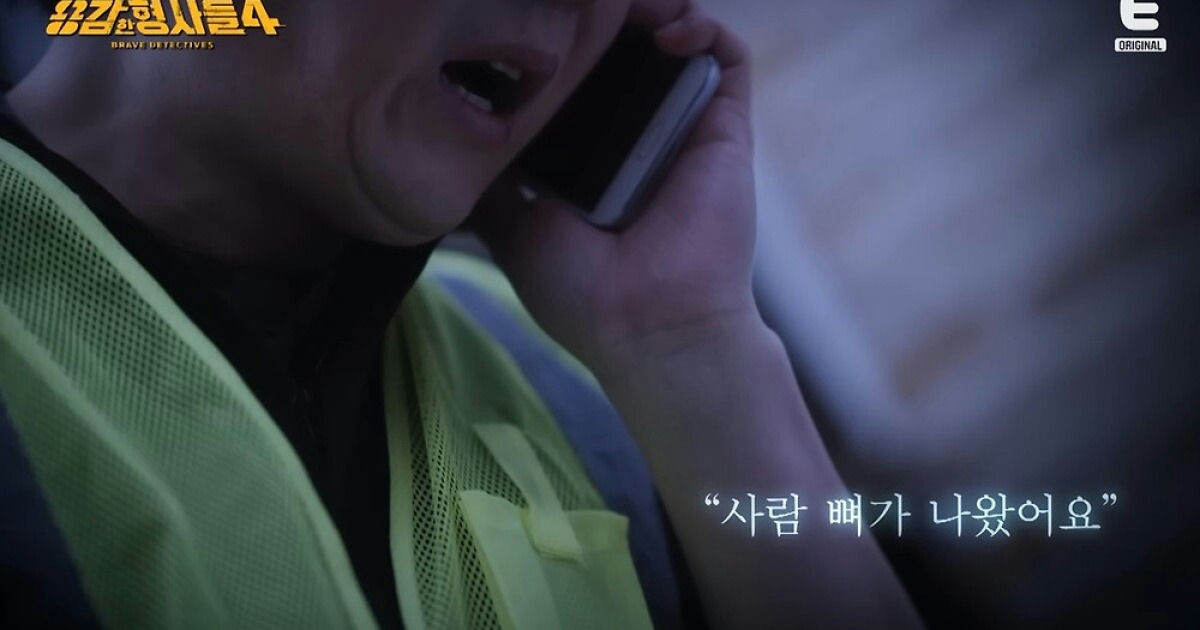
The case was introduced on the February 6 broadcast of Tcast E Channel’s Brave Detectives 4, featuring officers from the Namyangju South Police Station along with members of the narcotics unit, voice phishing task force, and the Korea Crime Scene Investigation (KCSI) team, who revealed detailed records of the investigation.
The incident began when workers cleaning a septic tank at a multi-family residential building discovered several long bones tangled in a hose. A total of seven human bone fragments were recovered. Based on their size, investigators estimated the victim was a small-built person approximately 150 centimeters tall. Since a parked car covered the septic tank opening, the possibility of an accidental fall was considered highly unlikely.
Detectives compiled missing persons reports from the surrounding area over the past decade. Their attention soon turned to the very building where the remains were found. During initial questioning, a male resident claimed he lived only with his wife and children. However, it was later revealed that his mother, in her 80s, had lived with them until five years earlier.
The missing person report had not been filed by the woman’s son, but by her grandson. The man’s wife told relatives and neighbors that her mother-in-law had run away from home, claiming even that a large truck had come to take her belongings. No witnesses, however, could confirm seeing this. DNA testing later confirmed that the skeletal remains belonged to the missing woman, matching her daughter’s DNA.

After separating the couple for questioning, police learned that the husband worked out of town and only returned home occasionally. He stated that he believed his wife when she told him his mother had left voluntarily.
The wife, however, could not identify any neighbor who had allegedly witnessed the disappearance. Her statements grew increasingly inconsistent. At first, she claimed her mother-in-law had already died, then later admitted she had pushed her during an argument and found her dead afterward. She ultimately refused to explain the exact cause of death.

She further alleged that when she returned home, the house was filthy with urine and feces, and that her mother-in-law had insulted her and accused her of infidelity. She claimed the body disposal occurred accidentally when, while carrying the body on a rainy day, she slipped and the septic tank lid opened, causing the body to fall inside.
Investigators, however, found that the elderly woman had no medical records indicating dementia, nor was she in a condition that would explain the alleged behavior described by the daughter-in-law. Despite strong suspicions, a lack of definitive evidence proving the exact killing process prevented prosecutors from charging her with murder.
In the end, the daughter-in-law was sentenced to three years in prison for the unlawful disposal of a body, leaving the case as one of the most disturbing examples of familial betrayal revealed on the program.
Sources: Daum
You must be logged in to post a comment.