
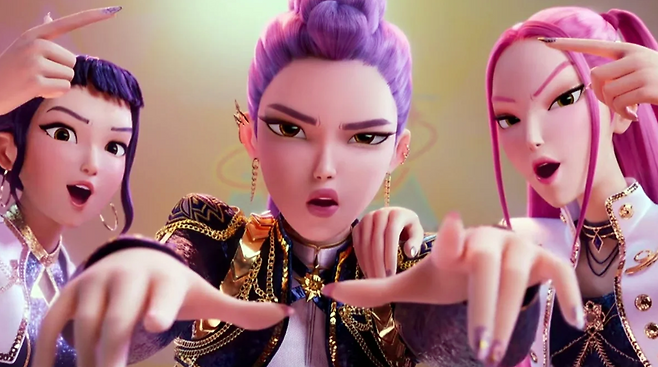
Netflix’s animated film KPop Demon Hunters has become a global phenomenon, recently climbing to No.1 in Japan after already dominating worldwide charts. Yet behind this belated success lies a wave of debates over dubbing quality and strong recommendations from fans to watch the subtitled version to fully capture the original emotion.
After its release, KPop Demon Hunters topped Netflix’s global rankings and made history on the U.S. Billboard Hot 100 and Billboard 200 by landing at No.1, showcasing the immense power of its KPop soundtrack. Its popularity sparked nationwide sing-along screenings in the U.S. and a deluxe album re-release that boosted both streaming and physical sales. On TikTok, the song Soda Pop was even dubbed the ultimate anthem of the Korean summer.

As the movie spread internationally, dubbed versions were produced in various countries. However, not all were well-received. In Japan, the local dub drew criticism for failing to preserve the emotional depth of the original. Many fans advised others to switch to subtitles for a more authentic experience.
The controversy also highlighted the current limits of AI dubbing technology. While capable of matching tone and rhythm to some extent, AI still struggles to convey nuanced emotions. This led to a mistranslation incident in which “sisterhood” was rendered as “family love,” sparking backlash and forcing Netflix to issue an apology.

The film’s success has even inspired Japan to explore similar concepts, with reports of a potential JPop Demon Hunters project. Although KPop Demon Hunters was produced by a Japanese-American studio and distributed by U.S.’s Netflix, its overwhelming KPop identity has underscored the genre’s cultural dominance, even within Japan.
Ultimately, KPop Demon Hunters is more than just a film; it’s a testament to how KPop has evolved beyond music into a global storytelling resource. By centering its narrative on idols, fandom culture, and stage performances, the movie proves that KPop can powerfully shape international entertainment narratives.
Sources: daum
You must be logged in to post a comment.